Howard—Amos Crane
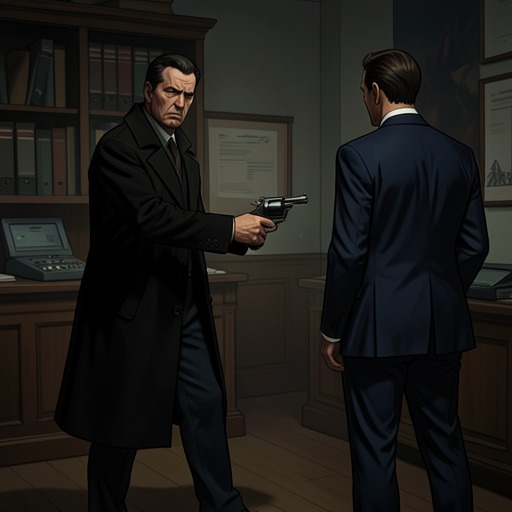
Down Cemetery RoadHoward and Amos Crane become threats to one another within a larger struggle over how its loose ends will be contained. Howard fears that Amos may bury him and resolves to act against him; Amos, arriving at the chapel, suspects Howard may have influenced Michael Downey’s escape with the child and counts Howard among those implicated in the ending. Their conflict is marked less by a direct exchange than by mutual calculation, suspicion, and the converging consequences of events neither man fully controls.
An Unfinished Chain
Howard’s danger begins to take shape as he tries to reconstruct who is moving around him. While tracking Sarah Trafford’s party, he recognizes the likely identity of the woman in the red jumper: the detective Sarah Trafford hired, whom Axel Crane had pacified. The recognition comes late, after Howard has already failed to attend to the details that might have made the connection clear. To him, this is the nature of loose ends: overlooked at the time, they unravel into a much larger problem.
That retrospective recognition gives the threat from Amos Crane a particular urgency. Howard wonders whether he can finish matters himself and considers the possibility that Amos might do it for him. But the uncertainty does not keep him passive. He decides he will have to get his hands dirty, because if he does not put Amos away first, Amos will bury him. The language makes the contest sound like a race to close the same case, but with radically different stakes: Howard’s attempt to contain the danger is also an attempt to stay alive.
The Chapel and Howard’s Suspected Role
At the chapel, Amos Crane surveys the gathering and understands that Michael Downey has come there after taking the child. He wonders how easily Downey managed it, then considers whether Howard might somehow have made it easier. This is speculation, not confirmation that Howard arranged or assisted the rescue. Its significance lies in what it reveals about Amos’s view of their conflict: he does not treat Howard as a distant bureaucrat, but as a possible participant in the chain of events now bringing them together.
Amos’s judgment hardens into a broader reckoning. He regards Howard as part of the ending, placing him alongside the immediate figures gathered beneath the chapel’s roof. The thought turns the location into more than a meeting point. For Amos, it is where the accumulated actions surrounding the child, Downey, and Howard’s influence may finally converge. Yet the evidence leaves the extent of that influence unresolved; Howard’s possible involvement remains a suspicion in Amos’s mind, not a disclosed fact.
Personal Threat and Institutional Reach
Howard’s fear of Amos is personal and immediate: he believes that failing to act first will leave him at Amos’s mercy. But Howard also speaks from a position backed by an organization. When Sarah Trafford considers killing him, Howard warns that his department would remain and retaliate against her and the people connected to her, including Michael Downey, the child, and Wigwam. He predicts that they would all meet with major accidents and invokes the possibility of a much larger emergency.
That warning is addressed to Sarah Trafford, not to Amos Crane, and it does not establish a direct confrontation between the two men. It does, however, clarify the unequal forms their threat can take. Amos is the danger Howard fears will personally destroy him; Howard’s own power extends beyond his individual survival through the department he represents. The relationship therefore sits between private mutual hostility and institutional violence: each man sees the other as part of the danger, while the machinery surrounding Howard threatens consequences far beyond their own contest.